







Key Concept
Monarchy – A monarchy is a state where political deliberation is performed by one person (generally a king or queen).


People often distinguish between “thinkers” and “doers”— typically to mock the thinker, such as the stereotypical philosopher who has their “head in the clouds”. However, philosophers themselves have treated thought and action to be fundamentally separate parts of human existence. Aristotle seems to do so in his distinction between theory (theoria) and practice (praxis); so does Immanuel Kant in his distinction between theoretical reason and practical reason. This has led scientific knowledge to be viewed as a purely passive recording of what is — a description of things that implies no action.
But is this correct? Are thought and action fundamentally separate? Certainly, action without thought tends to be aimless and reckless, while thought unconnected to action tends to be self-indulgent and detached from reality. Moreover, modern science has always held a necessary connection between theory and practice, or between thinking and doing. No theory is taken seriously in the sciences unless it is testable, that is, unless it can be put into practice. While often highly abstract, scientific thought typically goes hand in hand with strenuous, even messy, practical work. Consider, for example, the biologist who wades through a mosquito-ridden swamp, gathering and transporting samples.
Leave it, then, to a brilliant scientist-philosopher, Charles S. Peirce (1836–1914), to develop a “logic of science” that asserts a fundamental connection between cognition (thought or knowledge) and rational agency (conduct or deliberate action), so that there is no cognition that does not imply some conduct. This postulate would come to be expressed as pragmatism.
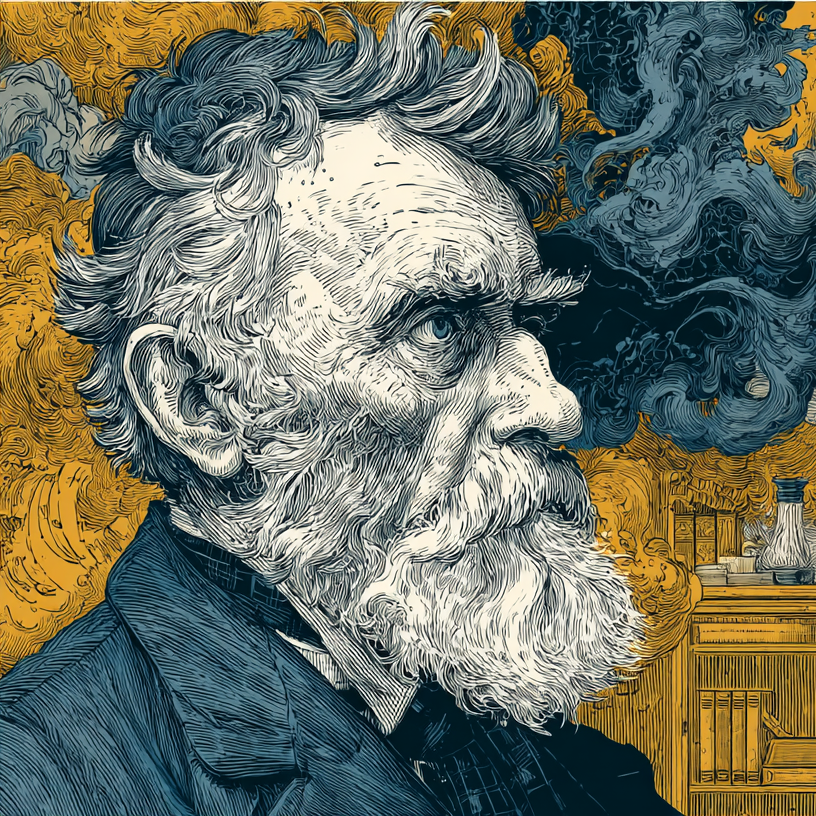
Charles Sanders Peirce was born into privilege on September 10, 1839, in Cambridge, Massachusetts. His father was a prominent Harvard mathematician and his mother was the daughter of a U.S. Senator. Despite having all the advantages early in life, and despite being praised for his genius throughout his life, Charles died on April 19, 1914, in Milford, Pennsylvania, after years of poverty, chronic illness, and relative obscurity. Yet, his life was not a tragedy. As the Oxford Handbook of Charles S. Peirce remarks, Peirce “would rather have lived conducting his research freely as he did than to lead a wealthy or at least more secure life without his research” (p. 22). Rarely discarding anything he composed, Peirce left behind thousands of pages of scientific and philosophical writings, the vast majority of which went unpublished during his lifetime, and some remain unpublished even today.
However, among the many articles Peirce did publish during his lifetime, two are widely regarded as the founding documents of the pragmatist tradition in philosophy: “The Fixation of Belief” (1877)—here abbreviated as FOB—and “How to Make Our Ideas Clear” (1878)—abbreviated as HTMOIC. Both appeared in the journal Popular Science Monthly and are the first two in a series now known as the Illustrations of the Logic of Science. “The Fixation of Belief” can be found here, and “How to Make Our Ideas Clear” can be found here. The page numbers I use throughout are from The Essential Peirce, Volume 1.
In these essays, Peirce introduces a rule for clarifying concepts by working out the “practical bearings” of the things that they are concepts of. Although neither essay uses the term “pragmatism,” William James, in his 1898 Berkeley address, recalls that Peirce referred to this rule in early 1870s conversations as “the principle of pragmatism.” Peirce later came to call it “the maxim of pragmatism,” and today it is commonly known as “the pragmatic maxim.”
Habit – Peirce takes all belief to consist in habits of conduct, and he takes all cognition to be geared toward the development of belief-habits.
Belief – Consists in habits, regarded by Peirce to be a resting place for thought or inquiry. The fixation of belief is the motivating goal of inquiry.
Doubt – Disturbs our belief-habits and motivates inquiry or the “struggle” to attain a state of belief. Asking a genuine question counts as doubt.
Inquiry – The “struggle” to fix belief and appease any doubt. According to Peirce, the only method of inquiry that fixes belief in the long run is the self-correcting method of science.
Grade of Clearness – A level of mastery over our own meaning, ranging from familiarity with a concept (the first grade) to describing the practical bearings of the object of the concept (the third grade). The rule for attaining the third grade of clearness is the maxim of pragmatism.
The origins of the maxim of pragmatism — and the connection between cognition and conduct that it presupposes — go back at least to two earlier papers by Peirce: “Questions Concerning Certain Faculties Claimed for Man” (1868) and its follow-up, “Some Consequences of Four Incapacities” (1868). In these essays, Peirce attacks a set of claims about mind and knowledge that he attributes to Rene Descartes, including the claim that we are capable of intuition. By “intuition,” Peirce means “cognition not determined by previous cognition”—that is, thought that is not inferred from other thought. Descartes takes the judgment “I am, I exist” to be intuitive in this sense, since he believes we can know it without inferring it from something else.
Peirce denies that we have any such capacity for intuition. He argues that “we have no power of thinking without signs” and that all signs require interpretation, which, in these works, he characterizes in terms of inference. Each interpretation is an inference, introducing another sign, and every sign is an interpretation of a previous sign, or a conclusion of previous inference. Thus, there is no “first sign” or “first cognition”. Rather, “cognition arises by a continuous process” (Page 72).
The movement from one sign to the next is an inferential step and that step, according to him, takes place through a habit. Earlier philosophers took all thought to consist in reproductions of sensations, such as David Hume, who added that thoughts are associated through habits. Peirce departs from such earlier philosophers by rejecting that thoughts are reproductions of sensations, and, instead, taking thoughts to consist in habits themselves.
Challenge: For one day, keep a journal of five moments when you noticed or thought something—anything from “that dog looks angry” to “I should call my friend.” For each one, pause and reflect: What prior experiences, assumptions, or habits made you interpret the situation that way? Could someone else reasonably interpret it differently?
Goal: To see firsthand that your perceptions and thoughts are not raw or intuitive, but interpretations built from habits of inference formed by past cognition.
FOB begins with a review of the history of scientific reasoning, from the syllogistic logic of antiquity to the Darwinian use of statistical reasoning. He notes that “Darwin, while unable to say what the operation of variation and natural selection in any individual case will be, demonstrates that in the long run they will adapt animals to their circumstances” (Page 153). This Darwinian statistical law inspires Peirce to propose a theory of scientific reasoning by which science advances through an analogous process, where instead of organisms adapting to their environment, it is our habits of mind adapting to reality. A habit of mind is good so far as it is so adapted.
FOB, The Essential Peirce volume 1, page 153
That which determines us, from given premises, to draw one inference rather than another, is some habit of mind, whether it be constitutional or acquired. The habit is good or otherwise, according as it produces true conclusions from true premises or not; and an inference is regarded as valid or not, without reference to the truth or falsitv of its conclusion specially, but according as the habit which determines it is such as to produce true conclusions in general or not.
Peirce then turns to the nature of belief and doubt. The former concerns when “we wish to pronounce a judgment” in any reasoning process while the latter concerns when “we wish to ask a question”. He argues that there is a practical difference between them.
FOB, Page 156
Our beliefs guide our desires and shape our actions. […] The feeling of believing is a more or less sure indication of there being established in our nature some habit which will determine our actions. Doubt never has such an effect. Nor must we overlook a third point of difference. Doubt is an uneasy and dissatisfied state from which we struggle to free ourselves and pass into the state of belief; while the latter is a calm and satisfactory state which we do not wish to avoid, or to change to a belief in anything else. On the contrary, we cling tenaciously, not merely to believing, but to believing just what we do believe.
Thus, both doubt and belief have positive effects upon us, though very different ones. Belief does not make us act at once, but puts us into such a condition that we shall behave in a certain way, when the occasion arises. Doubt has not the least effect of this sort, but stimulates us to action until it is destroyed. This reminds us of the irritation of a nerve and the reflex action produced thereby; while for the analogue of belief, in the nervous system, we must look to what are called nervous associations—for example, to that habit of the nerves in consequence of which the smell of a peach will make the mouth water.
As signs, beliefs involve habits of inference; but they also involve habits of action. Beliefs dispose us to act in certain ways on certain occasions. Note: habits of inference and habits of action are not merely the causes or the consequences of belief; they are the very essence of belief. This is made clearer in HTMOIC, in a long passage arguing that the function of thought or cognition is to establish habits of action, so that “the final upshot of thinking is the exercise of volition”.
HTMOIC, Pages 170-171
Thought is only one such system, for its sole motive, idea, and function, is to produce belief, and whatever does not concern that purpose belongs to some other system of relations. … But the soul and meaning of thought, abstracted from the other elements which accompany it, though it may be voluntarily thwarted, can never be made to direct itself toward anything but the production of belief. Thought in action has for its only possible motive the attainment of thought at rest; and whatever does not refer to belief is no part of the thought itself.
And what, then, is belief? […] We have seen that it has just three properties: First, it is something that we are aware of; second, it appeases the irritation of doubt; and, third, it involves the establishment in our nature of a rule of action, or, say for short, a habit. As it appeases the irritation of doubt, which is the motive for thinking, thought relaxes, and comes to rest for a moment when belief is reached. […] The final upshot of thinking is the exercise of volition, and of this thought no longer forms a part; but belief is only a stadium of mental action, an effect upon our nature due to thought, which will influence future thinking.
The essence of belief is the establishment of a habit, and different beliefs are distinguished by the different modes of action to which they give rise. If beliefs do not differ in this respect, if they appease the same doubt by producing the same rule of action, then no mere differences in the manner of consciousness of them can make them different beliefs, any more than playing a tune in different keys is playing different tunes.
Peirce argues that different beliefs are distinguished by different habits, regardless of whether we are conscious of the difference. Notice the break with Descartes and subsequent philosophers: what we believe is not best known through introspection; rather, what we believe is best known through our habits of action. And as the function of thought in general is the establishment of belief, so the function of thought is the establishment of habits of action. Next, we begin to see what this means.
Challenge: Identify a belief you think you hold—something like “eating healthy is important” or “people should be treated equally”—and test whether it truly functions as a belief by observing your actions across the next 24 hours. Ask yourself:
Does this belief influence how you act when the opportunity arises?
If not, what does guide your action in that moment?
Can you locate a real belief by seeing what habits your actions actually reveal?
Goal: To discover that belief is not what you merely say or feel you believe, but what manifests in your regular, habitual behavior. This reflects Peirce’s idea that belief is a rule of action, not a feeling.
Habit is a homeostatic state that resists change. So, in describing belief in terms of habit, Peirce presents belief as a resting place for thought. Yet questions and doubts pervade our lives, especially in science. Peirce introduces doubt as “an uneasy and dissatisfied state” and later calls it “the privation of habit.” He thus sees science as ultimately driven by the desire to reach belief and ease the irritation of doubt. This, he thinks, is the very nature of inquiry.

FOB, Page 156
The irritation of doubt causes a struggle to attain a state of belief. I shall term this struggle Inquiry, though it must be admitted that this is sometimes not a very apt designation.
The irritation of doubt is the only immediate motive for the struggle to attain belief. […] With the doubt, therefore, the struggle begins, and with the cessation of doubt it ends. Hence, the sole object of inquiry is the settlement of opinion. We may fancy that this is not enough for us, and that we seek, not merely an opinion, but a true opinion. But put this fancy to the test, and it proves groundless; for as soon as a firm belief is reached we are entirely satisfied, whether the belief be true or false. And it is clear that nothing out of the sphere of our knowledge can be our object, for nothing which does not affect the mind can be the motive for mental effort. The most that can be maintained is, that we seek for a belief that we shall think to be true. But we think each one of our beliefs to be true, and, indeed, it is mere tautology to say so.
Peirce then remarks how this overturns Descartes’s method of doubt, which he sees as relying on “paper doubts” rather than on genuine doubts. According to him, Descartes does not genuinely doubt that he is awake, sitting alone beside a fireplace, which makes the rest of his pursuit of an unshakable foundation for knowledge a sham inquiry.
However, Peirce acknowledges that, by his own definition, simply sticking to a belief tenaciously would count as a method of inquiry. He also agrees that this is what many people do much of the time. He calls it “the method of tenacity”. The problem with this method, he argues, is that it only works so far as we avoid people with contrary opinions.
FOB, Page 158
The social impulse is against it. The man who adopts [the method of tenacity] will find that other men think differently from him, and it will be apt to occur to him, in some saner moment, that their opinions are quite as good as his own, and this will shake his confidence in his belief. […] Unless we make ourselves hermits, we shall necessarily influence each other’s opinions; so that the problem becomes how to fix belief, not in the individual merely, but in the community.
However, the problem of fixing belief in the community has been solved simply through the imposition of authority: members of the community are simply not allowed to believe anything other than what the authority controlling the community says they can believe. Peirce calls this “the method of authority” and he argues that it too is unstable in the long run.
FOB, Page 160
But no institution can undertake to regulate opinions upon every subject. … But in the most priest-ridden states some individuals will be found who rise above that condition. These men possess a wider sort of social feeling; they see that men in other countries and in other ages have held to very different doctrines from those which they themselves have been brought up to believe; and they cannot help seeing that it is the mere accident of their having been taught as they have, and of their having been surrounded with the manners and associations they have, that has caused them to believe as they do and not far differently.
Eventually, doubts will wash over those for whom belief had been fixed by authority, and they will seek to fix their belief through some standard of reason or by what “seems reasonable”.
FOB, Page 160
This [third] method resembles that by which conceptions of art have been brought to maturity. The most perfect example of it is to be found in the history of metaphysical philosophy. Systems of this sort have not usually rested upon any observed facts, at least not in any great degree. They have been chiefly adopted because their fundamental propositions seemed “agreeable to reason.” This is an apt expression; it does not mean that which agrees with experience, but that which we find ourselves inclined to believe. … This method is far more intellectual and respectable from the point of view of reason than either of the others which we have noticed. Indeed, as long as no better method can be applied, it ought to be followed, since it is then the expression of instinct which must be the ultimate cause of belief in all cases.
This method of fixing belief, which Peirce calls “the a priori method,” has us reflect on questions or doubts until our rational instincts suggest an answer with which we feel satisfied. However, Peirce remarks, this method “makes of inquiry something similar to the development of taste”. He continues:
FOB, Page 161
[B]ut taste, unfortunately, is always more or less a matter of fashion, and accordingly metaphysicians have never come to any fixed agreement, but the pendulum has swung backward and forward between a more material and a more spiritual philosophy, from the earliest times to the latest. … This method, therefore, does not differ in a very essential way from that of authority. … [W]hen I come to see that the chief obstacle to the spread of Christianity among a people of as high culture as the Hindoos has been a conviction of the immorality of our way of treating women, I cannot help seeing that, though governments do not interfere, sentiments in their development will be very greatly determined by accidental causes. Now, there are some people, among whom I must suppose that my reader is to be found, who, when they see that any belief of theirs is determined by any circumstance extraneous to the facts, will from that moment not merely admit in words that that belief is doubtful, but will experience a real doubt of it, so that it ceases in some degree at least to be a belief.
Just as with the other methods, the “a priori method” has us fix our beliefs according to something that is ultimately irrelevant to the truth of belief, such as cultural norms and personal inclinations. Eventually, we would recognize that our beliefs are being fixed according to such irrelevant influences, and we would return to a state of doubt.
Due to the instability of the first three methods of inquiry to fix belief in the long run, Peirce introduces the fourth and, he argues, most stable method of fixing belief in the long run.
FOB, Page 161
To satisfy our doubts, therefore, it is necessary that a method should be found by which our beliefs may be determined by nothing human, but by some external permanency — by something upon which our thinking has no effect. … Our external permanency would not be external, in our sense, if it was restricted in its influence to one individual. It must be something which affects, or might affect, every man. … Such is the method of science. Its fundamental hypothesis, restated in more familiar language, is this: There are Real things, whose characters are entirely independent of our opinions about them; those Reals affect our senses according to regular laws, and, though our sensations are as different as are our relations to the objects, yet, by taking advantage of the laws of perception, we can ascertain by reasoning how things really and truly are; and any man, if he have sufficient experience and he reason enough about it, will be led to the one True conclusion.
With this, Peirce has reached his main point in FOB: given that belief is of the nature of habit, the most rational method of fixing belief, the most rational method of inquiry, is “the method of science”. Peirce does not suppose that this method is used only by scientists. However, the attempt to fix belief through close observations of and interactions with reality is more central to science than perhaps to any other human practice. We have a hypothesis that might ease our doubts, we test it against reality in some way, and the result either eases our doubts or intensifies them. Peirce suggests that if we have enough experience and reason enough about our experience, we would all be led to and rest upon the same conclusion.
In articulating the method of science, Peirce introduces a rather controversial idea: that the method would eventually lead all inquirers to the same conclusion. However, even if this were the case, why think that that conclusion would be true and correspond to reality? The subsequent article, HTMOIC, addresses this question. Although Peirce does not invent the maxim of pragmatism explicitly to support his theory of truth and reality, we will see how it does.
Let us begin with the maxim of pragmatism itself and then we will trace how he arrives at it. Peirce presents the maxim as follows.
HTMOIC, Page 174
Consider what effects, which might conceivably have practical bearings, we conceive the object of our conception to have. Then, our conception of these effects is the whole of our conception of the object.
That is, our concept of something, in its clearest apprehension, is a concept of its practical effects.
Peirce does not call this the maxim of pragmatism in this article. Instead, he refers to it as “the rule for attaining the third grade of clearness of apprehension.” What is a “grade of clearness” and what were the first two grades? To achieve a grade of clearness is “to know what we think” and to be “masters of our own meaning” (Page 168): the higher the grade, the better we know what we think and the better masters of our own meaning that we are.
Peirce defers to the “logic books” of his time in explaining the first and second grades of clearness: “[T]he books are right in making familiarity with a notion the first step toward clearness of apprehension, and the defining of it the second” (Page 168). The first grade is familiarity, whereby we “have such an acquaintance with the idea as to have become familiar with it, and to have lost all hesitancy in recognizing it in ordinary cases” (ibid.). Peirce notes that this “hardly seems to deserve the name of clearness of apprehension, since after all it only amounts to a subjective feeling of mastery which may be entirely mistaken” (ibid.).
We become clearer on a concept “when we can give a precise definition of it, in abstract terms” (ibid.). This is the second grade of clearness. However, Peirce laments that “[h]ere the professional logicians leave the subject,” and “in omitting all mention of any higher perspicuity of thought, they simply mirror a philosophy which was exploded a hundred years ago.” He is referring to Cartesian philosophy, which he rejects as exemplifying the a priori method of inquiry. “Nothing new can ever be learned by analyzing definitions,” Peirce argues; thus, he believes that modern science demands “a far higher grade than the ‘distinctness’ of the logicians” (Page 169).
Peirce’s habit model of cognition suggests a higher grade than abstract definition. He writes:

HTMOIC, Page 173
[T]he whole function of thought is to produce habits of action; and that whatever there is connected with a thought, but irrelevant to its purpose, is an accretion to it, but no part of it. … To develop its meaning, we have, therefore, simply to determine what habits it produces, for what a thing means is simply what habits it involves. Now, the identity of a habit depends on how it might lead us to act, not merely under such circumstances as are likely to arise, but under such as might possibly occur, no matter how improbable they may be. What the habit is depends on when and how it causes us to act. As for the when, every stimulus to action is derived from perception; as for the how, every purpose of action is to produce some sensible result. Thus, we come down to what is tangible and practical, as the root of every real distinction of thought, no matter how subtle it may be; and there is no distinction of meaning so fine as to consist in anything but a possible difference of practice.
We are fully clear in our ideas or conceptions when we have articulated the habits of action comprising them. The “practical bearings” or effects of a concept’s object are our general habits of action related to that object. In later writings, Peirce clarifies that the grades of clearness build on one another. Once we have abstractly defined a concept, the next step is to consider what that concept, so defined, means in practice. Peirce uses “weight” as a simple example: “To say that a body is heavy means simply that, in the absence of opposing force, it will fall”—that is, if you remove the supports of a heavy object, you will perceive it to fall. Similarly, to say something is hard is to say that if you try to scratch it, you likely won’t succeed. These are habits of expectation: let a heavy object go, expect it to fall; try to scratch a hard object, expect to fail. But the corresponding habits of action would be fleeing from under an object you judge to be heavy and avoiding attempts to dent or scratch an object you judge to be hard.
When Peirce applies the rule for attaining the third grade of clearness to the concept of reality, he first explains what reality is on the first two grades.
HTMOIC, Page 178
Taking clearness in the sense of familiarity, no idea could be clearer than this. […] As for clearness in its second grade, […] such a definition may perhaps be reached by considering the points of difference between reality and its opposite, fiction. A figment is a product of somebody’s imagination; it has such characters as his thought impresses upon it. That whose characters are independent of how you or I think is an external reality. […] Thus we may define the real as that whose characters are independent of what anybody may think them to be.
With this, Peirce argues: “The only effect which real things have is to cause belief, for all the sensations which they excite emerge into consciousness in the form of beliefs.” From here, Peirce summarizes the argument from FOB, that only the scientific method can fix belief in the long run because it appeals directly to an “external permanency” that affects us all. What habit of action, then, does the concept of reality involve?—the habit of inquiring according to the scientific method. Peirce thus arrives at his pragmatist clarification of reality.
HTMOIC, Page 180
The opinion which is fated to be ultimately agreed to by all who investigate, is what we mean by the truth, and the object represented in this opinion is the real. That is the way I would explain reality.
Peirce then addresses two concerns with this explanation of truth and reality. The first concern is that it conflicts with “the abstract definition which we have given of reality, inasmuch as it makes the characters of the real to depend on what is ultimately thought about them.” He answers this concern by modifying the abstract definition: “reality is independent, not necessarily of thought in general, but only of what you or I or any finite number of men may think about it”; similarly, “the object of the final opinion depends on what that opinion is, yet what that opinion is does not depend on what you or I or any man thinks.” The second concern is that there might be realities beyond the reach of science—so-called “buried secrets”. Peirce answer this, perhaps unsatisfactorily, with:
HTMOIC, Page 181
[…] who can guess what would be the result of continuing the pursuit of science for ten thousand years, with the activity of the last hundred? And if it were to go on for a million, or a billion, or any number of years you please, how is it possible to say that there is any question which might not ultimately be solved?
In other words, we are in no position to judge definitively what we cannot know. Some facts might seem forever buried, perhaps due to a practical or physical impossibility of testing for those facts. But we are far from reaching the bottom of what is and is not physically possible. The same with practical possibility. We cannot judge today what would be practically possible a million years into the future, or even a hundred years into the future.
Some events or facts might seem entirely lost, such as how Aristotle’s voice sounded, or the first instance of a self-replicating molecule on Earth. However, what if sound waves could leave microscopic traces in materials—vibrational patterns etched into clay, metal, or even paint? And what if we develop a physics that allows ultra-precise time-reversal of atomic configurations?
Raise two more examples of facts or events that might seem impossible for us to ever know, as different as possible from the examples given above, and then propose a “possible” way we might come to know it. Limit “possible” to what is physically plausible, even if that might require some revision to basic physics
Whether Peirce’s pragmatist clarification of reality survives philosophical scrutiny, the point is that we cannot have any sufficiently clear concept of a reality that we cannot, in principle, fix our belief upon—at least, not a concept sufficiently clear for scientific inquiry. Unknowable realities are pure abstractions that Peirce even regards to be nonsense. For him, the limits of understanding lie at the limits of possible conduct, and expressions of things that are beyond possible conduct are nothing more than verbalizations. Cognition and conduct are inextricably connected because thinking aims at belief and belief consists in habits of expectation and conduct. That idea is the essence of Peirce’s pragmatism.
If want to learn more about Peirce’s philosophy, The Essential Peirce Volume 1 & Volume 2 is the best concise collection of Peirce’s works. There are a few great introductions to his thought. First, Cornelis de Waal’s Peirce: A Guide for the Perplexed covers the basics of each part of his philosophy, and so does Albert Atkin’s Peirce. For Peirce’s place within the pragmatist tradition, see Catherine Legg’s entry for Pragmatism in the Stanford Encyclopedia of Philosophy.
This work has been adapted from “The Fixation of Belief”, a public domain copy uploaded on Philpapers, and from “How to Make Our Ideas Clear”, a public domain copy on wikisource. All images were created using Midjourney.
Wilson, Aaron. 2026. “The Logic of Habit in Belief and Inquiry: Charles S. Peirce’s The Fixation of Belief and How to Make Our Ideas Clear.” The Philosophy Teaching Library. Edited by Robert Weston Siscoe, <https://philolibrary.crc.nd.edu/article/logic-of-habit/>.
Monarchy – A monarchy is a state where political deliberation is performed by one person (generally a king or queen).
Phalaris (c. 570-549 BCE) was, by most accounts, the very opposite of Cyrus, and he was used as an example of tyrannical cruelty in antiquity. He was tyrant of Acragas (now Agrigento) in Sicily. Diodorus Siculus records an infamous account of Phalaris’s torturing his enemies in a bronze bull placed over a roaring fire.
Cyrus the Great (d. 530 BCE) was the first emperor of the Persian Empire and a commonly used exemplar of the “enlightened monarch” in antiquity. He was renowned for his tolerance and care for his subjects. Xenophon, a student of Socrates, wrote a partly fictionalized biography of Cyrus called The Education of Cyrus (Cyropaedia). Peter Drucker, an influential 20th-century management theorist, called the Cyropaedia the best book on leadership.
Republic (res publica) – Cicero’s short definition of res publica is res populi (the ‘people’s thing’). Later in the Republic, Cicero famously defines a republic (1.39) as an assemblage of people associated with each other by consensus on justice (ius) and mutual benefit (utilitas).
Scipio Aemilianus Africanus was a hero among many Romans, but his reputation today is far less straightforward. Scipio Aemilianus led a Roman military campaign resulting in the utter destruction of the city of Carthage in 146 BCE. The Carthaginians were a prosperous Phoenician people in North Africa and rivals to Roman power. It has been argued that this act of ‘national extermination’ meets the modern definition of genocide. How should this knowledge impact how we view Scipio’s political philosophy expressed here?
This famous phrase, known by the abbreviation SPQR (senatus populusque Romanus), served as something like the official title of the Roman state (compare ‘USA’, ‘USSR’, ‘UK’), and encapsulated the ideal of a res publica (common property in public hands shared between the people and a council of elders).
Contemplation: The activity of human beings’ rationality. Contemplation is more than just thinking; it’s thinking excellently about ultimate truths. Contemplation is the ultimate activity associated with human flourishing.
Eudaimonia: Often translated as ‘happiness’ (in this text) or ‘flourishing’, eudaimonia is the activity of living the best possible life for a human being. Eudaimonia is more than just feeling happy or contented – it’s the idea that there is a best way to live for human beings.
Virtue: Virtues are cultivated tendencies to perform our function excellently, which allow us to reliably do the right thing, to the right extent, for the right reasons, given the demands of a specific circumstance. There are three components of virtues: virtues involve (a) skillful activity – they’re excellences after all!, (b) proper motivation, and (c) appropriate judgment – they often lead to judgments about what is the right thing to do, which requires careful attention to the circumstances.
Pleasure: The enjoyable feeling that accompanies some activities. Some philosophers (but not Aristotle!) think that pleasure is the only thing that is good in itself
Endoxic Method: An argumentative structure that begins by laying out the endoxa, or the beliefs of the many or the wise, then raises apparent problems for those views and develops a resolution to those problems.
The Problem of Induction: A problem for reasoning about the future based on past experiences. How can we be justified in believing that patterns of events in the past will continue into the future?
A Priori: Hume is using the term ‘a priori’ to denote the kind of reasoning that allows one to gain knowledge as relations of ideas—in other words, reasoning from one necessary, definitional truth to another.
Justification: the concept of justifying one’s thinking, or one’s beliefs, is important in epistemology. Roughly, one’s thinking or belief is justified when there is good reason for it, or when it is well supported or well evidenced. All of these are ways of referring to some connection between what we think or believe and what is, or to some way of at least making ourselves think that we are closer to the truth.
Inference: The psychological process of moving from one thought to another, such as moving from the thought “it’s raining, and I don’t want to get wet” to “I should get my umbrella”, or from “I am tired, and it’s getting late” to “I should get some sleep”. Nowadays, philosophers tend to use the term ‘inference’ to mean the same as ‘reasoning’, and tend instead to use the term ‘association’ to refer to movements between thoughts that are not based on any logic or evidence.
Matters of Fact: Knowledge that is gained by experience, such as by observing or experimenting with objects in the world. For example, knowing whether all swans in the world are white requires somebody to examine the many swans in the world and make sure they do not happen to discover a black one (and in fact, there are black swans!).
Relations of Ideas: Knowledge that is gained just by sufficiently clear thinking, without having to observe or experiment with objects in the world. For example, knowing that a triangle has three sides is something you can know just because of what it means to be a triangle, hence without having to carefully examine triangular objects that you find throughout the world.
Reasoning: Developing arguments to try and support the truth of one’s beliefs.
Causation: A relation between events, where one event (cause) is responsible for another (effect). Eating too much chocolate can cause the effect of having an upset stomach, and not getting enough sleep can cause someone to be grumpy.
Epistemological Theories: Theories about the nature and possibility of knowledge – whether, when, how, and to what extent we can know about reality, such as the physical world, or our own consciousness. For example, one epistemological theory says that we can gain understanding of our own consciousness by studying the brain, whereas other theories say that we can only gain knowledge of consciousness by reflecting on our own inner experiences.
Aristotle means “happy” in the sense of a person who has developed a complete character, lived a full life, and become a true example of human goodness.
Happy Person – Someone who has developed her entire self well and lived a complete and flourishing life. She is a real and positive example of how we should live.
This is where Aristotle defines virtuous friends. These are friends who you actually answer the phone for. These are the friends who you ask for advice on work, love, and life. They are the friends that celebrate you for being you, but they also tell you when you’re messing things up. Not only do they love you, but you love them and try to be the same kind of friend to them too.
This is where Aristotle defines pleasurable friends. These are your TikTok, Snap Chat, or Instagram friends, the ones you post to social media when you’re having a good time.
This is Aristotle’s explicit definition of useful friends. These are your LinkedIn friends, those who you like networking with at events or enjoy working with on projects.
Virtuous Friendship – A friendship where people set as their goal for their friendship becoming good people together and living happy lives just because they value the good of their friends as persons. These are also known as “perfect” or “true” friendships. They are usually between people who are equally good. And they might be limited to people of equal social status, wealth, and power. Aristotle doesn’t think that any happy person will lack virtuous friends. But he thinks it’s likely that we’ll only have a few of this sort.
Pleasurable Friendship – A friendship where people set as their goal for their friendship some pleasant goal, such as friendship between people who go out on the town together. These friendships are plentiful and easy to form and dissolve.
Useful Friendship – A friendship where two people set as their goal for their friendship some useful or utilitarian purpose, such as friendship between work colleagues. These friendships are plentiful and easy to form and dissolve.
Aristotle uses “friend” broadly for any relationship between people who like each other, wish good things for each other, and get something out of spending time together.
Friendship – A relationship between two people who like each other, generally wish each other well, and have a goal for their interactions.
Happiness – The final end and highest good of human life. The perfect good that objectively fulfills human nature and subjectively satisfies desire.
Happiness Criteria – The conditions that the true object of happiness must satisfy. They are: finality, intrinsic value, purity, internality, authenticity, stability, self-sufficiency, completeness.
Object of Happiness – The thing in which happiness essentially consists, the attainment of which will make us truly happy.
Highest Good – The greatest good for a human being.
Final End – The ultimate goal of human life. All of our other goals are chosen for the sake of this final end.
Constituent Principles – Parts of a material object that cause the object to be the sort of thing that it is, but that cannot be removed from that object (in the way that some properties can be gained or lost). For Aquinas, this would include things such as form (the structure of a material object) and matter (that which is structured). For example, Dylan’s form is his soul, and his matter is his body. His soul and body are distinct, but Dylan could not exist if he were not composed of both.
Accident/accidental property – A property that something can possess or not possess while still remaining the thing that it is. For example, Dylan could grow taller, or he could stop being musical, without becoming a different person. By contrast, rationality is an essential property of Dylan, since being rational is part of the “what it is to be” of a human being.
Subject/Suppositum – Something or someone that can bear properties but is not itself a property that something else can bear. Dylan can have properties, like being short or being musical, but no one can have Dylan as a property.
Property – A feature that an object has. For example, a ball could be orange, which means that the ball has the property of orangeness. In many cases a property can be gained or lost. The ball could be painted green, in which case it would gain the property of greenness and lose the property of orangeness.
Actuality – The being, or act of being, of a thing. For example, hot water is actually hot (the water is hot), even though it is potentially cold. Likewise, a boy is actually a human being (he is a human being), even though he is also potentially a full-grown man (and he will still be an actual human being when he becomes a full-grown man).
Potentiality – Ways a given thing can become different from the way it is now. For example, cold water is potentially hot, since it can be heated up, and an acorn is potentially an Oak tree since it can grow to full size under the right conditions.
Essence – The “what it is to be” of a thing. For example, the essence of a human being is to be a rational animal, and the essence of a cheetah is to be the fastest land animal.
Principle of Specialization – The idea that work is more efficient and more effective if each worker specializes in exactly one task.
Extrinsic Value – Value a thing has that is dependent on something else. Extrinsically valuable things are worth pursuing because they get you something else that is valuable. Money, for instance, is only useful because it can be exchanged for other things.
Intrinsic Value – Value a thing has independently or inherently. Intrinsically valuable things are worth pursuing for their own sake.
Adeimantus and Glaucon were Plato’s older brothers (along with an older sister, Potone). They were both honored for military valor at a battle with Megara. We know little about their lives otherwise. Potone had a son, Speusippus, who inherited leadership of the Academy upon Plato’s death.
Thrasymachus was a real person, who lived about 459-400 BCE moved to Athens from Chalcedon to become a sophist (a professional teacher and public speaker). Only a few fragments of his work survives
Prudence – Prudence is virtue wherein a person is able to choose, in any given situation, the course of action that will lead to greater happiness. For example, a prudential person knows when it is appropriate to continue a difficult conversation and when it is best to wait for a more appropriate time.
Pleasure – Epicurus would have us think about pleasure as coming in two forms: moving and static. Moving pleasures are the type that we experience in the process of satisfying a desire (this coffee tastes amazing!). Static pleasure is the feeling of being satisfied — no longer experiencing need or want (I am feeling so peaceful sitting in the park). Epicurus thinks these static pleasures are the best sort.
Epicurus believed that reality is composed of matter. This sets him apart from other philosophers of the time who, often influenced by Plato, believed that reality is composed of both the material and immaterial (like the soul, or the Platonic forms).
Happiness – Epicurus uses the Greek word “eudaimonia,” which is typically translated into English as “happiness.” Whereas today happiness is most often used to describe a momentary feeling (this new notebook makes me happy!) Epicurus means something more like a consistent state of well-being and contentment.
Unconditioned: an ultimate explanation of reality. For example, if I explain why it is raining today by appealing to some atmospheric conditions, I can always ask for the cause of those conditions, and so on. Only a cause that is not caused by anything else (something unconditioned) would give us an ultimate explanation.
Transcendental Idealism: Kant’s mature philosophical position. It holds that appearances are not things in themselves, but representations of our mind. It is opposed to transcendental realism, which identifies appearances with things in themselves.
Appearances (vs. things in themselves): things as they are experienced by us (also known as phenomena). They should be distinguished from things as they are independently of our experience (things in themselves or noumena).
Metaphysics: the study of what there is. Traditionally, metaphysics is divided into general metaphysics and special metaphysics. The former investigates the general features of reality and asks questions such as ‘What is possible?’. The latter studies particular kinds of being and asks questions such as ‘Does God exist?’ or ‘Is the soul immortal?’.
Reason: the faculty that knows a priori. Kant uses this term in a general sense (the knowing faculty as such) and in a specific sense (the faculty that demands ultimate explanations).
A priori: term denoting propositions that can be known independently from experience. For example, propositions such as ‘All bachelors are unmarried’ or ‘The whole is greater than its parts’ can be known without recourse to any experience.
Make sure not to think that ‘unjustified’ means ‘false.’ Even if they are true, the point is just that this would not be something that had been shown.
‘Absolute’ might be a confusing word, here. Socrates means that the geometers are not reasoning about their drawing of the square, for example, but of the square itself. They do not conclude that, for the square they drew, the area is equal to the square of a side – they conclude that this is true for squares as an intelligible object, or, as Plato would say, the Form of the square.
By ‘science’, Plato means to be talking about all rational disciplines, including mathematics.
The form of the beautiful has to be perfectly beautiful because all instances of beautiful things are explained by it, so it has to be responsible for the highest possible degrees of beauty possessed by anything. Moreover, it has no trace of ugliness in it.
The form of the beautiful has to be immaterial because all the many beautiful things do not share any material – that is, they are all made of different stuff.
Form (εἶδος / ἰδέα) – Intelligible, immaterial, perfect entities that explain the unity among the many things which share the feature named by the entity (e.g., Beauty, Squareness, Oddness). For example, think of a square. There might be many different squares, but they all share features like having four sides of equal length. So, the Form of Squareness would include all of those features that make something a square.
Guardian – This is the name Plato gives to the ruling class in his ideal city. Think of them as philosopher kings – they have complete control over the organization of the state. The Republic is partially about why Plato thinks they would be needed for an ideal system of government and what they would need to learn to do the job well.
Plato has previously argued that we are made up of different parts. The first part is the appetitive which is responsible for our desires for food, sex, and other bodily needs. Then there is the spirited part, which longs for fame and honor. Finally, he identifies the rational part, which discerns what is good and bad for us through reason. The parts can all come into conflict with one another, and managing their relations is what Plato thinks justice is all about.
Soul (ψῡχή) – What Greeks meant by this word is controversial. For now, think of it as the thing that makes you different from a rock or other objects, the thinking and experiencing part of you as well as the part of you that acts and makes decision. You might use the word ‘mind’ or ‘self’ to talk about this.
Virtue – Virtues are the character traits that make a person good. For example, most people consider courage and generosity to be virtues. English-speakers usually reserve the word ‘virtue’ for human beings, but in ancient Greek the word can be more comfortably applied to other beings as well.
Was it his burly physique, his wide breadth of wisdom, or his remarkable forehead which earned him this nickname?
Aporia – A Greek term for “being at a loss” or “clueless.” Socrates often questions people until they have no idea how to define something that they thought they understood.
You might be confused by the word ‘attention’ below. In Greek the word is therapeia, from which we get the English word ‘therapy.’ It primarily means the same as ‘service’ as in ‘to serve,’ but shades into ‘worship,’ ‘take care of,’ and ‘attend to.’
Meletus – A poet and citizen of Athens and one of Socrates’ accusers. Amongst other things, Meletus accused Socrates of impiety and corrupting the youth.
Divine Voluntarism – The idea that God is free to determine even the most basic truths. If divine voluntarism is true, then God could have made it so that 2+2=5 or so that cruelty and blasphemy are holy and good.
Euthyphro Dilemma – The question, “Is a thing holy because the gods love it, or do the gods love it because it is holy?” The general idea of a forced choice (or “dilemma”) about the true order of explanation occurs often in philosophy and gets referred to by this term.
Essence – What a thing fundamentally is. A square might be red or blue without changing the fact that it’s a square, but a square must have four sides, so having four sides is part of a square’s essence.
Definition – The perfect description of a thing. A definition should pick out all and only examples of a thing. For example, ‘bachelor’ might be defined as ‘unmarried man,’ because all unmarried men are bachelors, and only unmarried men are bachelors.
In Disney’s retelling of the Hunchback of Notre Dame, the clergyman Claude Frollo orders the death of many Roma on religious grounds. It is clear, however, that he is really motivated by spite and his unrequited lust for the Romani woman Esmerelda.
Spanish conquistadors were shocked by the scope of ritual human sacrifice among the Aztecs, as hundreds or even thousands of people were sacrificed each year. The Aztecs thought that the sacrifices could repay the sacrifices the gods had made in creating the sun and earth.
Zeus – The god of sky and thunder in ancient Greek mythology, Zeus was depicted as chief among the gods and called the father of the gods and men.
Forms – The perfect, divine, and intelligible entities that exist independently of the physical world. They are comprehensible only through reason, not through our senses, and their existence explains the properties of objects in the physical world.
Recollection – The soul existed prior to birth; during this time it learned everything, and hence all learning is only recalling what we already know.
Immortality of the Soul – Unlike the body, the soul is not subject to physical death, because it is immortal and indestructible.
Philosophy – The practice of preparing the soul for death by training it to think and exist independently of the body
Death – Plato understands this as the soul’s separation from the body
Human Identity Across Time – Locke’s notion that any human stays the same across time if, and only if, it maintains the same (distinctively human) organizing structure of parts.
Substance Identity Across Time – Something is the same substance across a segment of time if, and only if, it continuously exists across the relevant segment of time without gaining or losing any of its parts.
Immaterial Soul – A personal thinking substance without any physical constitution.
Personal Identity Across Time – Whatever makes someone the numerically same person (i.e., that very person) at different times; according to Locke, it is a relation of first-person consciousness via memory.
Person – Locke’s forensic definition of person (pertaining to courts of law regarding the justice of praise, blame, reward, or punishment): a thinking, intelligent being, that has reason and reflection, and can consider itself as itself, the same thinking thing in different times and places.
The Prophet Muhammad is a central figure in Islam. He is viewed as the last of a long line of prophets, which includes Moses and Jesus. He is responsible for writing the Quran, which was dedicated to him by the angel Gabriel. His life and sayings are recounted in the Hadith; he is viewed as an exemplary role model of Islamic life and faith.
Exhortation — The method of understanding and interpreting Truth available to the common people. The majority of people take scripture literally and understand truth and right action based upon this understanding. They are persuaded by the vivid imagery of the Quran and the rhetorical exhortations of religious leaders. Averroes takes this to be lowest form of understanding
Dogmatic Discourse — The method of understanding displayed by those who, through natural ability and habit, are able to have a deeper understanding of the Quran, and of the truths it illuminates. These people know that not all of the scriptures are to be taken literally, and that greater underlying Truths are revealed by interpreting some elements allegorically. Still, they err on the side of dogmatism and literal interpretation whenever uncertainty arises. Averroes associates this way of thinking with Muslim theologians and views this to be the middle level of understanding.
Philosophical Inference – The type of understanding associated with philosophical demonstration or argument. This is the highest level of understanding, accomplished by a select few, who have a natural capacity for philosophy and proper philosophical training.
Law — The Quran (the central religious text of Islam) and, to a lesser extent, the Hadith (reports of what the prophet Muhammad said and did). Averroes is concerned with explaining how philosophy relates to what Muslims take to be the unerring Truth regarding God and the nature of existence, as they are expressed in Scripture.
Occasionalism — a theory claiming that God is the only true cause of changes in the world. For example, when you high-five me, you’re not really the cause of the stinging sensation I experience. God is the cause. Your high five is just the occasion on which God causes it.
Interactionism — a theory claiming that things in the world can truly cause changes in each other. For example, when you high-five me, you truly cause me to experience a stinging sensation in my hand.
Substance Dualism — a theory claiming that the mind (or soul) and body are two distinct and very different things.
Body — what it sounds like! The body is the physical part or aspect of a thing and has characteristics like shape, size, etc.
Soul — that part or aspect of a thing involving mental aspects of their existence, e.g., thoughts, feelings, decisions, etc. The “soul”, in this sense, is more or less just the mind.
Causal Interaction — When one thing acts (i.e., itself does something) and in so acting makes another thing change. For example, when you high-five me, you cause me to experience a stinging sensation in my hand.
God as God – The phrase “God as God” is basically a synonym for “God the subject.” In other words, it refers to God precisely in God’s status as an incomprehensible divine Other.
Incarnation – The Christian doctrine of the incarnation is the notion that the word of God became fully human in the person of Jesus of Nazareth. It is closely associated with the doctrine of the trinity, which asserts that God the Father, God the Son (Jesus as the word made flesh), and God the Holy Spirit are one God.
Religious Fanaticism – In Feuerbach’s use of the term, a religious fanatic is someone who is unwaveringly faithful to God as an utterly mysterious superhuman being. They subordinate other things—especially the love of other humans—to submission before this divine other.
God the Subject – When Feuerbach refers to God as a subject, he is referring to the commonplace religious belief that God is a being who has various attributes, like a loving nature.
Faith Separates Man From God – Faith separates God from man in this sense: it treats God as a mysterious other, a being radically distinct from us.
Faith – Belief in and fidelity to a transcendent divine subject like God.
Orthodoxy – Orthodoxy refers to “right belief,” and it is concern with identifying heresies and ensuring that people believe and practice correctly.
Indirect Form of Self-Knowledge – Feuerbach’s view is that religious belief is a naive way of relating to our human nature and its perfections. It is naive or childlike because it treats these as external realities that belong to God. He believes a mature and contemplative person realizes these don’t belong to God, but rather to our species, abstractly conceived.
Above the Individual Man – The human perfections are “above the individual” insofar as no particular individual ever perfectly realizes them. They are abstractions.
Divine Trinity – Feuerbach is having fun here. He is using the theological phrasing of the Trinity to talk about human perfections. In calling reason, love, and freedom of the will “divine,” he means they are absolutely good; they are activities whose goodness is intrinsic to their practice or exercise. This isn’t a novel philosophical view. For example, Immanuel Kant argued that autonomy or a good will is the only thing which is unconditionally good.
Perfections – The end to which a faculty or power is ordered. For example, omniscience would be the perfection of the intellect. Traditionally, God is said to possess all perfections.
Love – When Feuerbach writes about love, he is referring to unconditional concern for others and the desire for fellowship with them. He is here asserting that love, understood in this sense, is the perfect activity of the affective faculty. In other words, our feelings and passions are fully actualized and engaged in an intrinsically valuable activity when we genuinely love others.
Infinite – The infinite is whatever can be understood as unbounded or unlimited. Human nature in the abstract is unbounded and unlimited. It is only bounded or limited in its concrete form as it is realized by particular material individuals.
Higher Consciousness – The sort of consciousness that mature human beings possess, but which other animals do not. It is “higher” than animal consciousness because it involves thinking abstractly about the form or essence of things.
Science – Feuerbach uses the term science in its classical sense, meaning systematically organized knowledge. Any body of knowledge founded on an understanding of first principles and the essences of things is a science in this sense.
Popular Sovereignty – The view that a government’s authority to rule comes from the people, making a ruler subject to the will of their citizens.
The Divine Right of Kings – The theory that kings are chosen by God and thus that political revolt is a rebellion against the will of God.
Synthesis – The prefix ‘syn-’ means “together,” so a synthesis “brings together” or combines elements of both a thesis and its antithesis.
Antithesis– An antithesis is the contradiction of a thesis. For example, internationalism could be understood as the antithesis of nationalism.
Thesis – In Hegelian terms, a thesis can be understood as a position or theory. Examples include any of the “-isms” that we discuss in science, history, and philosophy, such as Darwinism, capitalism, nationalism, etc.
Progressor’s Temptation – a unique temptation for those making progress in which pride impedes their further progress and leads to backsliding.
Progressors – those who are not yet expert Stoic practitioners, but who are also aware of the fact that they must change their lives in that direction. They are working on making progress.
Intellectualism – the philosophical view that our motivations and emotions are all judgments. The reason why you do something, your motivation, is because you believe it’s the right thing to do. The reason why you feel good or bad about something, an emotion, is because you believe that something good or bad happened to you.
Duties – acts of service, obedience, and respect that we owe to each other. The duties we owe to each other depend on what kind of relationship we have.
Askeses – exercises of Stoic thought and practice that make the lessons and habits of Stoic philosophy second-nature for Stoic practitioners.
Externals – things that are not under our control but that are all-too-easily confused with things that should be important to us, like wealth, status, and pleasure. Too many people believe externals like these are necessary for the good life, and the Stoic path is to focus not on these things but rather what is up to us.
The Fundamental Division – the division between things that are under our direct control and those that are not. The important lesson is to care only about the things we can control.
The Greatest Happiness Principle – A principle which says that actions are right insofar as they promote happiness and wrong insofar as they promote unhappiness
Higher and Lower Pleasures – Types of pleasures that differ in terms of their quality. Things like food and drugs create lower pleasures. Things like intellectual pursuits and doing the right thing create higher forms of pleasure.
The Doctrine of Swine – An objection that utilitarianism entails that if people would be happy rolling in mud, that’s what would be morally best for them to do, so we should reject the theory.
Utilitarianism – A normative theory of which actions are right or wrong. Utilitarianism says the right action is that which maximises utility.
Jeremy Bentham – Considered by some as the father of utilitarianism, Bentham was a moral philosopher and one of John Stuart Mill’s teachers
Epicurus – an ancient Greek philosopher and one of the first to advocate that the ultimate good is experiencing pleasure and avoiding pain.
Utility – The thing that is ultimately valuable in itself. For Mill, this is happiness, which he then understands as pleasure and the absence of pain.
Contract Theory – a modern political theory identifying consent as the sole justification for government. Contract theory is associated with Thomas Hobbes (1588-1679), John Locke (1632-1704), Jean Jacques Rousseau (1712-1778), and more recently, John Rawls (1921-2002)
Prejudice – a foundational, strongly held, unreasoned (but not necessarily irrational) moral opinion or belief. We might believe, for example, that parents have special obligations towards their own children.
A Priori – a philosophical term of art meaning (in Latin) “prior to experience,” which refers to knowledge that is innate or arrived at purely through reasoning, like the truths of mathematics.
Rights – moral claims invoking immunity from (or entitlement to) some specific treatment (or good) from others. Commonly recognized rights include the right to free speech or the right to healthcare.
Reform – a change in the social order that originates from the existing character of society. An example would be market-based healthcare reform in a capitalist society.
Conservatism – a modern political ideology that aims to preserve and promote the existing (or traditional) institutions of society. These institutions typically include the rule of law, property, the family, and religion.
Contingent Being – A being that can fail to exist. Its existence is not guaranteed. This being might come to exist or it might not.
Necessary Being – A being that can’t fail to exist. Its non-existence is impossible. This also means that such a being has always existed.
Want to read more about why the infinite regress option doesn’t work in the Second Way? Check out Sean Floyd’s entry in the Internet Encyclopedia of Philosophy.
Efficient Cause – An efficient cause is something that directly makes another thing exist or move. An example of this is when I kick a ball down a hill. I am the efficient cause of the ball rolling down the hill because I make it move down the hill.
Infinite Regress: Begin with some fact. We begin to explain that fact by appealing to another fact, where these facts are related by either causality or dependence. To create the regress, you keep appealing to more and more facts about causality and dependence without end.
Actuality – An ability or action something is currently exercising. Imagine that I am sitting comfortably at my desk, and then I stand up to take a break from reading. In this case, I am now actually standing.
Potentiality – What something has the capacity to do, but isn’t currently doing. Imagine I am sitting comfortably at my desk. Even though I’m not currently standing, I have the capacity to be standing. So, even while I’m not standing, I have the potential to stand.
Theists and Non-Theists – A theist is someone who believes that God exists, while a non-theist does not. Non-theists include atheists, who believe that God does not exist, and agnostics, who are uncertain about whether God exists.
Glaucon – one of Plato’s brothers and one of Socrates’ main interlocutors in the Republic dialogue. In that dialogue, he challenges Socrates to provide a compelling justification for why one should be a just person beyond merely following conventions or avoiding punishment. This sets up Socrates’ defense of justice as intrinsically worthwhile. Throughout the Republic, Glaucon prods Socrates to fully explain his theories of the ideal society, philosopher-kings, and the Form of the Good.
Aristotle – a Greek philosopher (384-322 BC) who studied under Plato and went on to be one of the most influential philosophers to ever live. Simply called “The Philosopher” by Thomas Aquinas and others in the medieval period, Aristotle’s views would eventually be synthesized with Christian theology, laying the intellectual foundation for later scholarly developments in Western Europe.
Understanding – Socrates describes education as turning one’s “understanding” in the right direction. The word “understanding” here translates the ancient Greek term “to phronēsai,” which means “understanding,” “being conscious,” or “having insight.” People who are wicked focus their “understanding” on how best to accomplish their selfish and narrow desires. Those who are wise, in contrast, have learned to focus their “understanding” on what is truly good and beneficial.
The Form of the Good – Socrates characterizes the ultimate goal of education as coming to know “the Form of the Good.” The Form of the Good is his technical term for the meaning of goodness: what it is to be good. Socrates is clear that this “knowledge of the Good” is not simply theoretical knowledge, but also knowledge in the sense of “knowing how”: knowing how to achieve what’s good, to do what’s good, to accomplish what’s good. Mere “book knowledge” or simply being smart is not enough.
The Intelligible – Socrates uses “the intelligible” to name the aspects of the world that we can only grasp through thinking or insight. With my eyes I can see the tree outside my window, but what it means to be a tree is something I can only comprehend in thought. Likewise, I can see the people around me, but human nature, human dignity, and what it means to be human is something I can only grasp conceptually. “The intelligible” is the world insofar as it “makes sense” and can be comprehended.
The Visible – By “the visible,” Socrates means those aspects of the world we can perceive with our five senses and our imagination—those aspects of the world we can see, hear, taste, smell, touch, and imagine. For example, with my eyes I can see the sky, trees, people around me, and so on as visible things. “The visible” is the world insofar as it can be perceived and imagined.
Education – Socrates says that the allegorical story he tells represents the effect of education on human nature. “Education” here is a translation of the ancient Greek word “paideia,” which means “education” in the widest sense of the term. “Paideia” doesn’t mean “education” in the sense of going to school or getting good grades. Instead, it refers to the process of becoming a wise, intelligent, good, and well-rounded human being.
Allegory – An allegory is a symbolic narrative where characters, events, and/or settings represent abstract ideas or convey deeper meanings beyond the literal story. Socrates tells such a symbolic narrative in the passages below. The characters, events, and setting of his narrative symbolize the effect of what he calls “education.”
Self-knowledge – Knowledge of the contents of one’s own mind, such as one’s own beliefs and desires. Self-knowledge can be gained through introspection, that is, by reflecting on what one thinks and experiences. Some philosophers believe that self-knowledge has special properties that our knowledge of the external world lacks, such as being clearer, more reliable, or more valuable.
Dualism – The view that the mind is entirely distinct from the body. This view is usually contrasted with different kinds of monism, which hold that the mind is ultimately just a part of the body (materialism) or that the body is ultimately just a part of the mind (idealism). Dualists hold that the mind and the body are fundamentally different aspects of reality, and both categories are needed to properly describe the universe, especially the human person.
The Self – What the ‘I’ in ‘I am, I exist’ refers to; the part of you that really makes you you. Many philosophers have provided rich accounts of what the self ultimately is, including the soul, the mind, one special feature of the mind (such as consciousness), a mixture of all these elements, or perhaps a mere illusion.
The ‘Cogito’ – Descartes’ famous claim ‘I think, therefore I am’ is often referred to as the cogito. The name comes from the Latin rendering of this phrase, which is ‘cogito, ergo sum.’ Descartes held that one can always believe this proposition with certainty. We cannot doubt our own existence, so the cogito survives his exercise of intense doubt. The cogito appears several times in Descartes’ writings, and he often phrased it slightly differently each time. It appears in the Second Meditation as ‘I am, I exist.’
Certainty – When one believes something with certainty, one is maximally confident that it is true. A certainty is something that is beyond dispute or immune to doubt. Although this captures the basic idea, like many epistemological notions, clarifying precisely what the notion of certainty amounts to is an ongoing area of philosophical research.
Vice – A bad habit that we learn over time through instruction or instinct and that we develop through repetition. What makes the habit bad is that, once we have that habit, our tendency is to do the incorrect thing in certain types of situations. We may choose to do something entirely uncalled for in that situation, or we may act at the wrong time, in the wrong way, to the wrong degree, or with the wrong attitudes, or for the wrong reasons.
Relative Mean – The “Goldilocks amount” of some type of action or emotion. When you act in this way, according to Aristotle, you act exactly as is required under the current circumstances. This means that you do what is called for by the situation at hand, rather than doing something too extreme or not doing something extreme enough. You do something in the moderate amount (the mean amount) relative to the specific situation you are in when you need to act.
Excellence/Virtue – A good habit that we learn over time through instruction and repetition. What makes the habit good is that, once we have that habit, we have a strong tendency to do the right thing at the right time, in the right way, to the right degree, with the right attitudes, whenever we are confronted with a situation that we know calls us to exercise that habit.
Doxastic Voluntarism – the view that we have at least some control over what we believe.
Evidence – information that increases the probability that a claim is true.
Sufficient – enough of something for a particular purpose. Whether something is sufficient is context-dependent.
Solon – In the Histories of Herodotus, Solon visits Croesus, the king of Lydia. Even though Croesus shows Solon all of his wealth, Solon refuses to call him the happiest man who ever lived because he does not know how Croesus will die
Priam – According to Greek mythology, Priam was the final king of Troy during the Trojan War. Despite his wealth and political power, he was killed by Achilles’ son Neopotolemus during the Sack of Troy
Virtue – The consistent and reliable tendency to perform one’s function excellently. When a person has a certain virtue, like courage, they have spent time developing the habit, in this case reacting to danger well, using their human abilities. The virtues then make it possible for us to live a life of flourishing
Sardanapalus – An Assyrian king described by the historian Diodorus as living a life of extreme decadence. Sardanapalus indulged himself with food, alcohol, and many concubines, even going so far to say that physical gratification is the purpose of life. Chrysippus said that, on his tomb is inscribed the following: “Though knowing full well that thou art but mortal, indulge thy desire, find joy in thy feasts. Dead, thou shalt have no delight […] I have only what I have eaten, what wantonness I have committed, what joys I received through passion; but my many rich possessions are now utterly dissolved.”
Function – the characteristic activity of a given thing which makes it what it is. The function of a knife is cutting, while the function of a heart is to pump blood
Eudaimonia – Frequently translated as ‘happiness’, eudaimonia means the attainment of active human flourishing, and is the end Aristotle identifies as humanity’s highest final good
Final Good – A good that we pursue for its own sake. Common examples of final goods include happiness, knowledge, and friendship
Instrumental Good – A good that we pursue for the sake of some other good. A common example is money, as money allows us to purchase other kinds of goods
Anytus – an Athenian politician, war general, and one of the primary accusers behind Socrates’ prosecution. Anytus feared that Socrates would undermine the young Athenian democracy he had helped create and defend
Oracle of Delphi – the high priestess at the temple at Delphi, the oracle was one of the most sought after seers of the ancient world and was thought to relay messages from the god Apollo
Chaerephon – an ancient Greek from the city Sphettus, Chaerephon is remembered as a loyal friend of Socrates, also making an appearance in two other Platonic dialogues, the Charmides and the Gorgias
Meletus – A poet and citizen of Athens and one of Socrates’ accusers. Amongst other things, Meletus accused Socrates of corrupting the youth
Apollo – the ancient sacred site Delphi was dedicated to the god Apollo, an ancient Greek god and the god that Socrates refers to throughout the Apology
Virtue – a character trait, acquired through habitual practice, that enables one to act well. The virtues can also be thought of as excellences of human character, as they make it possible for us to live a life of flourishing. Examples of the virtues include courage, prudence, and justice
The Evil Demon Argument – Argues that we cannot hold any of our beliefs with certainty because we could be radically deceived by an evil demon. A classic argument given by Descartes for doubting the reliability of almost all of our beliefs
Philosophical Skepticism – The position that we do not know many things that we ordinarily take ourselves to know
A Posteriori Knowledge – Knowledge that can only be acquired through having particular, concrete experiences. Such knowledge can be gained simply through our everyday experiences, or through more complex means like controlled scientific experiments
A Priori Knowledge – Knowledge that can be gained without having any particular concrete experiences. Such knowledge is typically gained by rational insight or intuition
Cartesian Method of Doubt – A process employed by René Descartes of rejecting all beliefs that he had at least some reason to doubt in order to see if he had any beliefs that he could know with certainty
Revelation – Theological truths that have been made known by means of some religious text, testimony, authority, or experience, or the act or process in which such truths are made known.
Rationalism – The view that the only reliable means of coming to know truths about God is reason. As a result, what we might otherwise believe by means of faith ought to be disregarded or even rejected in favor of what we must believe by means of reason.
Fideism – The view that the only reliable means of coming to know truths about God is faith. As a result, what we might otherwise believe by means of reason ought to be disregarded or even rejected in favor of what we must believe by means of faith.
Faith – The act of accepting a proposition as true for which there is less than demonstrable evidence, which rises above mere opinion but falls short of logical or scientific demonstration. Faith can also refer to a particular religious tradition or the body of beliefs that are central to that religious tradition.
Virtue – a character trait, acquired through habitual practice, that enables one to act well. The virtues can also be thought of as excellences of human character, as they make it possible for us to live a life of flourishing. Examples of the virtues include courage, prudence, and justice
Socratic Ignorance – an awareness of one’s own ignorance, and the reason that Socrates was deemed wise by the Oracle of Delphi. A person who lacks Socratic Ignorance may believe they know many things they actually don’t, leading them to overestimate how well they understand the world
Apology – a formal defense of justification of an action or belief. A Christian apologist, for example, is someone who defends their faith and seeks to justify it through an appeal to reason.